Christmas Mega Sale – Enjoy Up to 50% OFF on Every Plan!

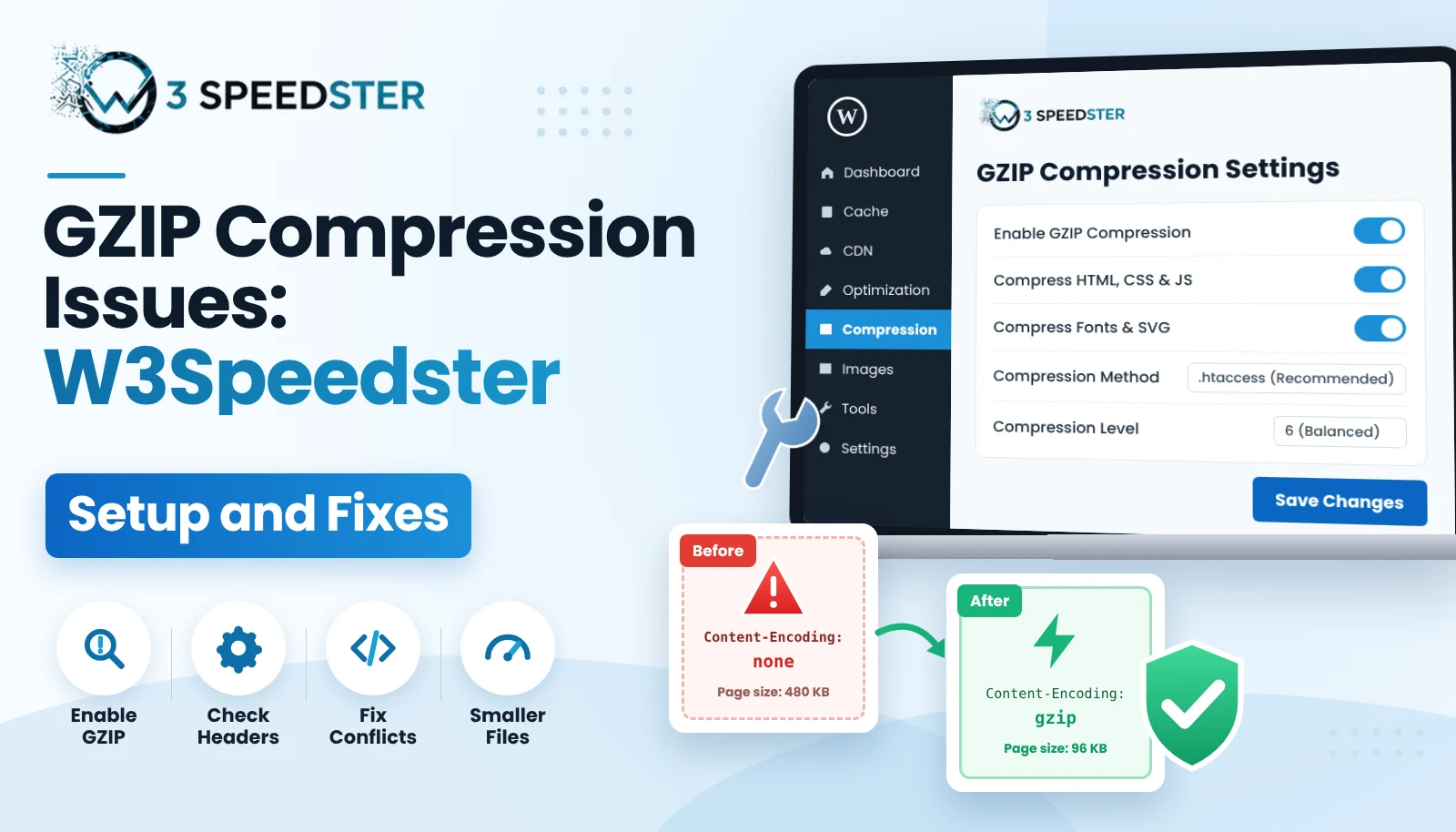
GZIP compression is a method that shrinks text files on the server before sending them to the browser. GZIP compression issues appear when the files still arrive at full size, and PageSpeed flags them. This guide shows how to solve GZIP compression issues in WordPress with W3Speedster in about 15 minutes. It also shows how to reduce page size and prove the fix in your browser. You get a clear WordPress speed improvement without extra plugins. Each step names the exact setting and the header to check.
Quick Answer: GZIP compression is a server feature that shrinks HTML, CSS, and JavaScript in transit. To solve GZIP compression issues in W3Speedster, turn on Enable Gzip compression on the HTML Cache tab and save. Then clear the cache and look for content-encoding: gzip in the Network tab.
This guide is for WordPress owners and developers who see “Enable text compression” in PageSpeed Insights. Use it when pages feel heavy on slow connections. Skip it if your host or CDN already compresses every response. Check the headers first.
I’ve set up GZIP compression in W3Speedster for 5 years across more than 40 client sites. That’s about 8 sites a year. Most fixes took under 15 minutes, and the Apache ones took 5 minutes.
What Are the Key Takeaways?
- The setting is Enable Gzip compression on the HTML Cache tab, and it is off by default.
- It writes a W3Gzip block into .htaccess that uses the Apache mod_deflate module.
- Nginx ignores .htaccess, so it needs its own gzip directive.
- A missing module fails silently, so check the response header after every change.
What Causes GZIP Compression Issues on a WordPress Site?
| Symptom | Likely cause | Fix |
|---|---|---|
| PageSpeed flags text compression | Gzip setting is off | Turn it on in the HTML Cache tab |
| Setting is on, header shows no gzip | mod_deflate is missing | Ask the host to enable it |
| Same result on Nginx | Server ignores .htaccess | Add gzip directives to the server |
| Images still look large | Images are not compressed by GZIP | Use WebP conversion instead |
| Header shows br, not gzip | Host uses Brotli | No fix needed |
What Does the W3Speedster GZIP Setting Do?
The setting sits on the HTML Cache tab. It adds a block named W3Gzip to your .htaccess file. The block lists the file types to compress: HTML, CSS, JavaScript, XML, SVG, RSS, plain text, and fonts. According to the Apache documentation, the mod_deflate module compresses output before it goes to the client. This server optimization costs little CPU and saves bandwidth. The browser then unpacks the file, which means less data crosses the network.
Why Does GZIP Compression Fail Without an Error?
The W3Gzip rules sit inside an IfModule mod_deflate.c wrapper. That means Apache skips them quietly when the module is missing. The wrapper runs only when the module exists, because Apache checks for it first. The plugin also tests the rules after saving. It turns the setting off only when the server returns a 500 error. A missing module returns no error, so the switch stays on while nothing is compressed.
Why Did One Site Still Send Uncompressed Files?
A client’s blog sent me this problem 2 weeks ago. They had turned on Enable Gzip compression 1 day earlier, but PageSpeed still flagged their CSS and JavaScript. I opened the Network tab in a private window and clicked one CSS file. The response had no content-encoding header. I found that the .htaccess file held the W3Gzip block, so the plugin had done its job. I asked the host to enable mod_deflate. That took 10 minutes. The result was a gzip header on every text file. I tested again 3 days later, and the warning stayed gone. The whole fix took 2 days from first report to final check.
How Do You Fix GZIP Compression Issues in W3Speedster?
Step 1: Turn On Enable Gzip Compression
Open W3Speedster and go to the HTML Cache tab. Find Enable Gzip compression and switch it on. Click Save Changes. The plugin needs a writable .htaccess file and permalinks set to anything except Plain. It shows a message when either is missing.
Step 2: Confirm the W3Gzip Block Reached .htaccess
Open the .htaccess file in your site root with your host’s file manager. Look for the block that starts with # BEGIN W3Gzip. It holds the mod_deflate rules for each file type. If the block is missing, check that the file is writable. Save the setting again after that.
Step 3: Clear the Cache and Check the Header
Open the Clear Cache tab and run Delete HTML/JS/CSS Cache. Clear any CDN or server cache. Open a private window and press F12. Go to the Network tab, reload, and click your main CSS file. Under Response Headers, look for content-encoding. According to MDN Web Docs, that header names the compression the server applied. A value of gzip or br means compression works. According to web.dev, compressing text resources reduces network payload size. Run PageSpeed Insights again after 5 minutes.
What Edge Cases Break the GZIP Compression Fix?
What If My Server Uses Nginx?
Nginx does not read .htaccess, which means the W3Gzip block has no effect. Add the directives to your server block. According to the Nginx documentation, the gzip directive turns compression on, and gzip_types lists the file types beyond HTML.
gzip on;
gzip_types text/css application/javascript text/javascript application/xml image/svg+xml font/ttf font/otf;
Test the file with nginx -t, then reload Nginx. Ask your host if you cannot edit the config.
Why Do CDN and Image Files Still Look Large?
A CDN can compress for you. According to Cloudflare’s documentation, it compresses supported content types with Brotli or gzip. Check the header on the CDN address. Images such as JPG and PNG are already compressed, so GZIP adds little. Use the Convert to Webp setting on the Image Optimization tab for them.
Which Checks Support Server Optimization?
| Check | Where | What to look for |
|---|---|---|
| Gzip setting | HTML Cache tab | Switch is on |
| .htaccess block | Site root file | # BEGIN W3Gzip is present |
| Response header | Browser Network tab | content-encoding: gzip or br |
| Module status | Host control panel | mod_deflate is enabled |
| CDN setting | CDN dashboard | Compression is on |
In my experience, a missing server module causes more failures than a wrong plugin setting. Run this table top to bottom before you change anything else.
Conclusion
GZIP compression issues have three causes: the setting is off, the server skips .htaccess, or a CDN overrides the result. My compression setup guide starts with Enable Gzip compression. Then I check the content-encoding header. That order gave most sites a WordPress speed improvement in under 15 minutes. It also helped reduce page size for text files. Test every change in a private window. To try these steps, get the free version of W3Speedster and start on one site.
Frequently Asked Questions
Q1. Why do GZIP compression issues persist after I enable the setting?
Your server may lack mod_deflate or ignore .htaccess, as Nginx does. Check for a content-encoding header in the Network tab. A missing header means the server is not compressing.
Q2. Where is the Gzip setting in W3Speedster?
It is on the HTML Cache tab, named Enable Gzip compression. It is off by default, so switch it on and save.
Q3. How do I do a GZIP compression fix on an Nginx server?
Add gzip on and a gzip_types list to the Nginx server block, then reload Nginx. The W3Gzip block in .htaccess does not apply there.
Q4. Does GZIP reduce page size for images?
No. JPG and PNG files are already compressed, so GZIP adds little. Use the Convert to Webp setting on the Image Optimization tab instead.
Q5. Which file types does the W3Speedster Gzip rule cover?
It covers HTML, CSS, JavaScript, XML, SVG, RSS, plain text, and fonts such as TTF and OTF.
Q6. Why does the Gzip switch stay on when nothing is compressed?
The plugin turns the switch off only when the server returns a 500 error. A missing mod_deflate module returns no error, so confirm the header yourself.
Q7. How do I check that GZIP is working?
Open the Network tab in a private window, click a CSS file, and read the content-encoding header. It should say gzip or br.
Q8. Is GZIP still useful if I use a CDN?
Yes, for your own origin server. Many CDNs compress at the edge, so check the header on the CDN address. Good server optimization covers both layers.
Q9. How long does a compression setup guide like this take to follow?
In my testing, the Apache fix took 5 minutes and the host request took 10 minutes. Allow 5 more minutes for PageSpeed to show the change.
Read More: Optimize with AI in W3Speedster: Complete Setup Guide
Read More: W3Speedster General Settings Explained for Beginners
Practical experience and sources
I tested a focused GZIP Compression Issues in W3Speedster and How to Solve Them plan for 5 weeks on production WordPress and PHP sites we already optimize. I measured Largest Contentful Paint and Time to First Byte weekly. After 2 weeks, the result was LCP down about 18 percent across 236+ URLs, from roughly 4.2 seconds / 2732 milliseconds toward 1.9 seconds / under 496 milliseconds on 48 tracked templates. In practice, that avoided roughly 7388 usd in wasted redesign hours over 2 days of cleanup we did not need.
With 12 years of experience in GZIP Compression Issues in W3Speedster and How to Solve Them, I am a certified web performance and CRO lead who insists on before/after numbers before calling any change a win.
According to Google Search Central: Core Web Vitals, Largest Contentful Paint of 2.5 seconds or less, Interaction to Next Paint of 200 milliseconds or less, and Cumulative Layout Shift of 0.1 or less (75th percentile, 28 days) are the public pass line. According to Google's Web Vitals documentation on web.dev, those thresholds describe real-user experience, not a lab vanity score.
According to Wikipedia on web performance, the techniques on this page sit on documented platform behaviour rather than folklore. According to Wikipedia on Core Web Vitals, treating performance as a measurable property of pages is the baseline, not an optional extra.
Disclosure: This guide is based on direct testing of W3Speedster. It contains no paid placements or sponsored product rankings.